Archive for March, 2014
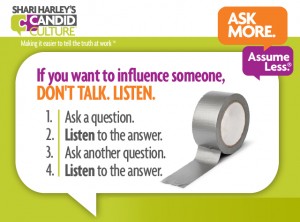 When selling a product, service, or idea, people often think that providing more information is better. The more data points, the more likely the other person is to be persuaded. This is not necessarily the case. Excluding data hounds, most people don’t like to be overloaded with information. But people do appreciate the opportunity to talk about what they want and need. So if you want to sell something, give people a chance to talk.
I’ll never forget one of my first sales calls, many years ago. I was selling Dale Carnegie Training. After calling a prospect for six months, he agreed to spend ten minutes with me. Feeling rushed, I laid out all of our training brochures and quickly told him about every program we offered. Then I asked if he wanted to buy anything. He didn’t.
If I had asked a few questions and listened to his answers, I could have provided information on just the training programs he needed, instead of giving him a list of likely irrelevant options.
Selling a product or service is no different from selling an idea. You are trying to persuade someone to your way of thinking. Resist the temptation to persuade solely by educating. Instead, ask questions, listen to the answers, and then tell the person what you heard her say. If you’ve taken a listening class, you learned the practice of paraphrasing what someone said. Paraphrasing is a very old technique, but still very effective.
People need to feel heard and understood. From my experience, asking relevant questions, demonstrating that you listened to the answers by paraphrasing what the person said, and providing pertinent and succinct information is what people need to make a decision.
Click here to download five free questions from our box of Candor Questions for Sales and Customer Service.

You know when someone gives you ‘the tone’. Similar to when people roll their eyes at you, when you get ‘the tone’ you’re being told that the other person is exasperated.
 Tone of voice communication is one of the hardest things to coach because we don’t hear ourselves. People who give people ‘the tone’ rarely know they’re doing it. One of the best ways I know to effectively coach tone of voice is to ask tone givers to tape themselves during phone calls. Then listen to the recording together and ask the tone giver, “If your grandmother called and someone spoke to her that way, would you be happy?” You can also read written correspondence out loud, adding the tone you ‘heard’, and ask the sender how she would have interpreted the message.
When given the tone, most people feel judged. And when people feel judged, conversations are constrained.
The way to avoid giving ‘the tone’ is to come from a place of curiosity. When you ask the question, “What were you thinking when you approached the customer that way,” you can sound curious or judgmental. Being judgmental evokes defensiveness, which shuts conversations down. Being curious creates discussion.
Consider asking questions like these to invite discussion:
• Tell me more about…
• Help me understand what happened here…
• What are your thoughts about…
• What’s the history behind….
• Why do we do it this way?
Any of these questions will lead to good discussion, if you manage your tone.
If you want to get information or influence someone, ask questions and engage the person in a dialogue. We often try to persuade people by giving them information. This rarely works. Instead of over loading people with data, ask questions which evoke discussion. Through discussion you might get to a different place. And if not, you’ll at least have learned why the other person thinks as he does and you will have shared your point of view in a way that is inviting versus off putting.
It’s easy to give people ‘the tone’ when we’re tired and frustrated. Try to avoid difficult conversations when you’re tired or stressed. Wait to have important conversations until you know you can manage yourself and your tone.
Conference calls taken on speaker phone, listening to music without headphones, and a posse of visitors, make the people working in a cubicle nearby want to permanently work from home.
The key to being able to ask your coworkers to move the conversation to a conference room is the same as giving any type of feedback –set expectations and ask for permission to speak candidly.
 Working in a cubicle is challenging. Here is some language to make it easier to ask your coworkers to pipe down:
Get the people who sit in your work area together to talk about your working environment.
That conversation could sound like this, “It’s often pretty loud in our work area. I was wondering if we could set some guidelines of how we’ll manage our workspace, so it works for everyone? What do you think of establishing some practices we all agree to follow? For example, when making or taking phone calls, everyone will either use the handset or a headset. We won’t take or make phone calls on speaker phone. We’ll always use earphones if listening to music or watching videos. If a conversation in a cubicle lasts longer than five minutes, people will take the conversation to a conference room. And when these guidelines are broken, and they will because we’re human, it’s ok to say something.
We could even have a system to let people know it’s getting loud and that a guideline is being broken. With everybody’s agreement, we could throw a nerf ball into the loud cube, put a note in front of the person, or simply walk over and ask the person to take the conversation elsewhere. I want our work environment to work for everyone and make it easy for us to speak up without being concerned that we’re going to hurt someone’s feelings or damage relationships. What do you think?”
You DON’T need to be a manager to do this. Take control of your working environment by asking for what you want. Initiating this conversation may feel odd and uncomfortable, but I assure you most of the people you sit with will be grateful you had the courage to start the conversation.
 You can say anything to anyone at work when you have permission to do so. Suffering is optional. Make requests today and follow up when things get loud. You can do it!
Read How to Say Anything to Anyone and get the words to make even the hardest conversations easy!
I could give you a list of fifty employee retention strategies you could follow to improve employee performance, engagement and retention. But the truth is, there are really just four things you must do. Employees may appreciate the other 46 things but don’t necessarily need them to stay with your organization and do their best work.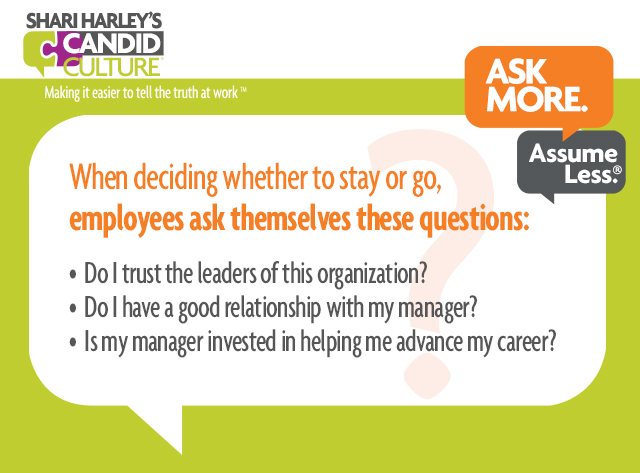
The Colorado Society of Human Resource Management hosts an annual Best Companies competition, and organizations of all sizes compete. Last year I led a workshop before the awards ceremony. The purpose of the workshop was to share the things that make an organization a great place to work. While researching the program, the things that separate the great companies from the less desirable places to work became very clear. I’ll share those employee retention strategies here.
Employees ask themselves these questions at work:
- Do I trust the leaders of this organization?
- Does my opinion/voice matter in this organization?
- Do I have a good relationship with my manager?
- Is my manager invested in helping me advance my career?
Employees enjoy yoga, concierge service, espresso, and social events at work, but these perks don’t necessarily improve retention or performance. The only perk known to improve employee loyalty and commitment is a flexible schedule. Everything else is nice to have, but not essential.
This is what’s really important to your employees:
- I trust the leaders who run this organization.
- My opinion means something. I am listened to.
- I feel respected (by my manager) and have good relationships in the organization.
- My work is challenging and interesting.
So what should you do if you want to be a best place to work?
Four Employee Retention Strategies Leaders Can Use to Create Relationships with Employees at All Levels:
1. Know employees’ names, talents & career goals.
2. Be visible. Talk to employees.
3. Give more information than you think you need to. Employees want to know how your organization is performing.
- Hold town hall meetings. Give financial updates.
- Use ‘Ask the CEO’ boxes to encourage questions and feedback.
- Encourage senior leaders to conduct small, roundtable discussions with employees at all levels.
4. Align leaders’ words and actions.
- Organizational guidelines are applied consistently among all employees.
- Don’t gossip or chuck other leaders under the bus.
- Be consistent. Don’t say, “The CEO says this, but we’re going to do this instead.”
Four Employee Retention Strategies Managers Can Take:
1. Meet one-on-one with employees and have meaningful discussions about employees’ performance and career goals.
2. Ask employees for their opinion and demonstrate that you’ve heard them.
3. Provide opportunities for employees to do work they enjoy.
4. Ensure employees who want to advance in your organization are learning and growing.
Read about our Be a Great Place to Work leadership training program designed for Senior Leaders and HR Professionals.