Archive for October, 2013
 Coming to work in costume on Halloween? Whatever you wear to work is likely to be captured by someone’s phone and shared . . . widely.
None of these are work appropriate Halloween costumes:
- Your boss
- Your boss’s spouse
- An employee who is “regrettably” no longer with the organization
- Whatever fit ten years ago
Sometimes people forget that work parties are still work and work appropriate Halloween costumes should be worn.
This reminds me of a participant I had in a public speaking class several years ago. While doing a presentation, in class, he told a story about being ten years old and playing outside in his neighborhood when he realized he needed to go to the bathroom. He raced home, but didn’t make it. He ended up going to the bathroom outside, next to his house. After that class, every time I saw the guy in the hallway at work, I had the image of him pooping next to his house and years later the image remains with me.
Telling that story was a bad call. It created a long-lasting impression I doubt he wanted his co-workers to have.
Impressions are made more quickly than they are forgotten. Have fun on Halloween, just not too much fun. If you wouldn’t want to see a photo of you in costume hanging in your organization’s lobby or on your website, don’t wear it to work.
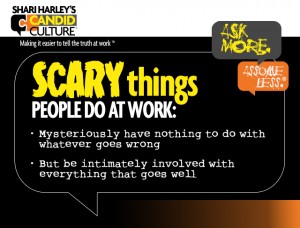 Taking credit for others’ work is not unusual or mysteriously having nothing to do with things that go wrong. It happens, sometimes purposefully, sometimes not. The key is what we do when things like this happen.
I’m going to suggest that you use the lowest level of intervention possible to resolve challenges. Give feedback while allowing people to save face. Don’t back people into a corner from which neither they nor your relationship can recover.
When your coworker is taking credit for others’ work, you could say:
1) “I noticed that when talking about project X during last week’s department-wide meeting, my name wasn’t mentioned in conjunction with the project. Why is that?”
Or you could say:
2) “Thanks for highlighting the X project during last week’s department-wide meeting. I’m glad the project got some exposure. I noticed that my name wasn’t mentioned in conjunction with the project. I want people to know they can come to me with questions about this project. In the future, will you tell people that I wrote the plan?”
Feedback can be given directly, “You did X and it frustrated me.” Or feedback can be given by asking a question and making requests, “Will you be sure to mention my name when you talk about X project?”
Some might call option one passive and even a disingenuous. Both methods produce the desired result –the other person knows that you know what happened, and you’ve requested different behavior. One method may incite conflict, one most likely won’t.
Be as direct as your relationship will allow. There are people with whom you can be very direct, without consequence. And there are some relationships that can’t withstand direct feedback.
Most of the people I talk with in organizations believe they can’t give feedback without negative consequences. The only way to know how direct you can be is by trial and error. Give a little feedback, see how it goes. Give some more, see how it goes. You might be surprised at how honest you can be. And when there is backlash for giving direct feedback, next time, give less. Ask a question or make a request instead. Asking questions is another form of feedback. It’s just less direct and thus less confrontational.
We train people to treat us as they treat us. You will get both what you ask for and what you allow. What are you allowing?
Written by Shari Harley owner and President of Candid Culture a training and development company making it easier to tell the truth at work.
 You get an email that annoys you, hit reply, type up your thoughts, hit send and feel instant regret. We’ve all done this. We’re frustrated and we let the other person know.
Feedback via email is always a bad idea. You don’t know how the recipient will read and interpret your message. You can’t manage the tone of the message or give the person a chance to respond. And more often than not, he’ll reply equally frustrated. And now the non-conversation begins –back and forth, back and forth.
Email is for wimps and voicemail isn’t any better! No texting either. End the madness and pick up the phone or swing by someone’s desk. Things are resolved most quickly and easily by talking about them.
I’m consistently surprised at how much feedback is delivered via email. And I’ll admit to occasionally being guilty of it too. I’m in a hurry or on a plane, and I want something to get done quickly. Or my emotions get the best of me, and I feel compelled to respond to a situation quickly. So I send an email or a text message that I know I shouldn’t send. Then I regret it and spend the rest of the day apologizing and feeling badly for communicating impulsively.
If we want people to want to work with us and perform, we need to consider how our actions impact them. Yes, it’s easier to send a quick email or text. But it invariably annoys the other person and damages your relationships. People can work with you, around you, and against you. If people want to work with you, they’ll work harder and produce better work.
Never underestimate the human ego, which is easily bruised. You are ALWAYS dealing with someone’s ego. The ego needs to be seen as good. When someone (anyone) calls our competence into question, we get defensive. Becoming defensive when receiving negative feedback or when someone questions us is a gut reaction. Not becoming defensive takes a great deal of self-management and is unusual.
Slow down. When you have to give feedback, ask yourself what you want the other person to do. Then ask yourself, how do I need to communicate to get the result I want? Then pause, breathe, and pick up the phone.
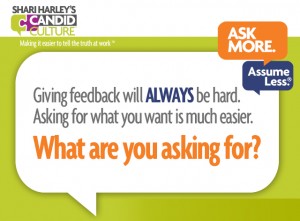 My last few blog posts focused on giving feedback. The posts were designed to help managers get ready to write and deliver performance appraisals.
Giving feedback will always be hard. No one wants to hear that she isn’t doing a good job, thus no one wants to tell her. Part of the performance appraisal process is setting expectations for the next year. And asking for what you want, before problems happen, will always be easier than giving feedback.
If you’ve seen me speak or attended one of our training programs, you received a list of Candor Questions designed to eliminate the guessing at work. They may have been questions for leaders, managers, strengthening business relationships or managing careers. Regardless of which Candor Question Cards you received, the goal is the same. Ask more. Assume less.
The most frequent request I get is for feedback training. Managers tell me, “The communication in our company isn’t good. Can you help our managers and employees be more candid?” And I tell business leaders, “I teach people to be more comfortable giving feedback. But why start with something hard? Why not start by asking more questions and getting to know people better, which is much easier and will reduce the number of feedback conversations you need to have?”
When we know what people expect, we can give people what they need. We make fewer ‘mistakes’, requiring fewer feedback conversations. So start with what’s easy. Ask more questions.
Start with what I call Introductory Candor Questions:
- How do you like to receive information – email, voicemail or text message?
- Are you a detail-oriented or a big-picture person? How much information do you want to receive and in what format?
- What are your pet peeves at work? What would I do that would be frustrating, and I’d never know it?
Then move on to Candor Questions for Managers:
- What had you choose to work here, and what would make you question that decision?
- What kind of work do you love to do most? What kind of work do you like to do least?
- What do you wish I would start, stop, and continue doing?
You can download samples of our seven types of Candor Questions here.
People are not us and don’t do things the way we do. Don’t assume someone will create a report as you would, participate in a meeting as you would, or dress for an event as you would. Setting expectations before the event of what you want, gives them a chance to be successful.
Giving Feedback is Hard – Asking for What You Want is Easier. By Shari Harley.