Archive for August, 2013
 You’ve undoubtedly heard that it takes fewer than 30 seconds to form a first impression. The question is how frequently is your first impression wrong?
If the person sitting next to you on a plane doesn’t speak to you during the entire flight, you may initially think he is unfriendly, only to strike up a conversation as the plane is landing and find out that’s not the case. If a job candidate is outgoing, you may decide she has good people skills, only to experience contrary behavior when she starts the job. If someone is late to arrive for an initial meeting, you may decide he has an issue with time management, versus he was just running late that day.
Many things go into forming a first impression. People who are tall and attractive – by societal standards – are typically perceived as likable and credible. It’s assumed that people with degrees from good schools are smart. But we all know people who went to good schools who we wouldn’t hire.
Your first impression may be right and it may be wrong, but it takes more than 30 seconds to be sure.
If you’ve participated in job interview training, you were probably trained to look for contrary evidence when forming an opinion about a candidate. Looking for contrary evidence is an attempt to disprove your first impression. If you quickly dismiss a candidate for lacking knowledge of your industry, you should ask interview questions to disprove your opinion before making a final decision.
Why not follow this practice in all settings? If you initially decide someone is trustworthy and reliable, spend more time with that person to be sure. If you quickly decide someone is unhelpful and uncommitted, give the person additional opportunities to behave differently before making a final judgment.
Snap judgments eliminate lots of great people and experiences from our lives.
Unfortunately just as we prematurely exclude potential employees, friends, and life partners without having enough information, people do this to us as well, which is why it’s important to know the first impression you, your department and your company make. If you don’t know the first impression you create, there’s nothing you can do to shift behaviors that may be costing you friends and customers.
I started asking the first impression I create after I got chucked under the bus by some coworkers. When I was new to one of my jobs, I asked my coworkers to give me feedback if they saw me do anything that got in the way of my being successful on the job. They agreed. But when they had negative feedback, they didn’t give it to me, they told my boss instead.
That’s when I got the hard and painful lesson that people have a tendency to talk about us, not to us. It’s also when I began asking the people closest to me, who I know love me and care enough to tell me the truth, the first impression I create.
Opinions are formed quickly and they’re hard to break. Give people more than one chance, and see how they show up. And know that many people will eliminate you, your department and your company after just one interaction. So find out the impression you create, giving you the power to do something about it.
Download some of the questions I ask to learn my reputation, here.

 Giving negative feedback is hard. Asking for what you want will always be easier.
Set Expectations That Are Clear
We have all worked hard on a project, only to find out that what we created is not what our manager was expecting. When this happens, everyone is frustrated. Managers question whether or not employees listen. Employees wonder why managers who want something specific didn’t just say so when the work was assigned.
Managers would be well served by setting clear expectations at the beginning of working relationships and projects. Tell your employees what a good job looks like. Don’t make them guess.
If you want a weekly status update, tell employees that rather than being frustrated when you don’t know where projects stand. If you want a bulleted summary, tell people that rather than being annoyed when five paragraphs land in your inbox. If you envision a report with tables and charts, tell employees that versus being disappointed when they create a bulleted list.
Most of us assume people will do things the way we do. They won’t. Save time and reduce frustration by being crystal clear when you set expectations at the beginning of anything new.
When people see the title of my book How to Say Anything to Anyone, they think it’s a book about giving feedback and having difficult conversations. It’s not. How to Say Anything to Anyone is about asking more questions, so you know what your direct supervisor, coworkers, and customers need and don’t have to guess. How to Say Anything to Anyone is not about giving people bad news. It is about asking for what you want before challenges occur, and then talking about how you’ll deal with challenges when they arise.
If you work for someone who does not set expectations that are clear, then you, the employee, needs to set those expectations.
Set expectations by asking your manager:
• When do you want to see this, in what format, with how much detail?
• What does a good job look like?
• What’s your expectation of how this should look when it’s complete?
• Where does this fit, as a priority, in relation to other projects?
• How does this project fit into the department’s or organization’s goals?
Asking questions and telling people what you want is always easier than giving negative feedback. Everyone – employees and managers alike – are accountable for ensuring that the set expectations are clear and that work is done right the first time Ask more. Assume less.
Download the five questions managers must ask their employees to set expectations that are clear:
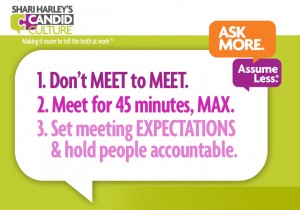 Meetings go long. Attendees stealthily text under the table like no one can see them. One person talks the whole time, while everyone else rolls their eyes. The decision maker isn’t there, forcing you to have another meeting. All the while, the facilitator does nothing.
Sound familiar?
The amount of time wasted in unproductive meetings and the degree of frustration meeting participants feel is astronomical.
The solution is simple.
Set clear meeting expectations at the beginning of EVERY meeting and hold people accountable when they violate the guidelines.
Most meeting facilitators don’t set expectations at the beginning of meetings. Instead they expect attendees to follow the unstated, assumed guidelines. And when the meeting facilitators’ boss, peers or customers are on their phone, it’s too hard to say something. So facilitators ignore the behavior, hoping it will stop without intervention.
The key to getting what you want in meetings (and in life) is to ask, which for the most part, we don’t. We assume people will do things as we do.
Tips for Running a Good Meeting:
1. Set meeting expectations at your next meeting.
2. Write the expectations on a flip chart and hang them up at the beginning of every meeting. Or download our meeting expectations poster and hang it in your conference rooms.
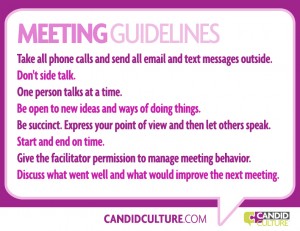
3. Review the meeting expectations every time you meet, even with groups who meet weekly.
4. Ask meeting participants’ permission to manage meeting behavior. Your role as the meeting facilitator gives you the right to address bad meeting behavior. Asking for permission and letting people know you will say something if you see their phone etc., makes it easier to speak up.
5. Tell participants they are expected to hold themselves and each other accountable.
6. Then hold people accountable for following the meeting expectations. If you ask people not to side talk, address side talking when you hear it. If you ask people not to be on their laptops or phones, ask people to put them away. If one person talks too long, interrupt him. You will have no credibility if you set expectations but don’t hold people accountable.
The reason facilitators don’t hold people accountable is that they feel uncomfortable. It’s hard to tell your peers, boss and other coworkers not to talk in circles. It’s almost impossible if you don’t set expectations about meeting behavior and set the expectation that you will say something when the meeting expectations are violated.
The simple act of setting meeting expectations and asking people’s permission to manage to those expectations makes doing so easier. Not easy, but easier. Asking your boss to put her phone away will never be easy, but it will be easier if you let her know BEFORE she pulls it out that you’ll do so.
You may be thinking, “I don’t run these meetings. I’m an innocent victim.”
As a meeting participant it is frustrating to go to poorly run meetings. But it’s also your role to speak up when you see things going poorly. Go to the meeting facilitator and give feedback. If you’re not sure what to say, follow The Feedback Formula outlined in my book How to Say Anything to Anyone.
Express empathy: “That Wednesday team meeting is tough. I wouldn’t want to run it.”
Ask permission to give feedback: “I’ve got a few observations and suggestions. Is it ok if I share them?”
Give feedback: “I’ve noticed that several people have been missing the meeting and others are on their phones and laptops during meetings. This definitely limits what we can get done and must be frustrating to you. What are your thoughts?”
Make a suggestion: “What do you think of setting meeting expectations at the next meeting and then telling people you’re going to hold them accountable?”
Offer help: “You’re not alone in this meeting. I’d be happy to tee up this discussion and explain why we need to set meeting expectations. What do you think?”
The facilitator knows the meetings aren’t going well. She just doesn’t know what to do. Offer to help. Don’t judge. She might be more receptive than you think. And you can stop suffering through poorly run meetings.
 When I was in college I wrote a paper making the case that most of the decisions we make are based on fear. My professor told me that I wouldn’t want the grade she’d put on the paper and told me to rewrite it. Many years later, I still believe the premise of what I wrote.
We often make decisions based on fear of what will and won’t happen.
Is that a good decision? What will happen if I say or do that? Will I get in trouble? Will I get what I want, or will there be negative consequences? Will we make or lose money? What impression will that decision make on other people?
Fear is pervasive. It hides in our brain and guides our decision making, without us even being aware of its presence.
I’ll never forget driving up to an ATM machine with one of my closest friends from high school. We were 30 at the time, long past high school, and were in a very quiet and safe neighborhood. And yet my friend told me not to go to the ATM machine after dark because it wasn’t safe.
Says who? A long time ago, someone told her that it wasn’t safe to go to an ATM machine at night. And she believed that she’d be robbed at night, at any ATM machine, anywhere, throughout her adult life. Not a rationale fear.
Who is running the show, you or your past?
You know what’s best for you. When you quiet the noise in your head and listen, you know what to do. Trust yourself.
 Tap into your real desires. When desire overtakes fear, the world will be at your feet. But it can take a lot to even identify that fear is running the show and to know what those desires are.
Many of you know I’ve never been married. I’ve found finding ‘that person’ elusive and challenging. This spring I met someone great. And I did everything in my power to make sure the relationship went nowhere. I put up every barrier, citing reasons from my list of dating criteria of why it would never work. My ‘list’ didn’t let me see the person in front of me. I made decisions about him that weren’t true, because I was afraid. It took weeks before I was willing to make the leap, put aside my fears, and be able to hear what my gut was telling me.
Trust yourself. Not your fear. When fear rears its head, go to a quiet place, literally and figuratively, and ask yourself:
What do I really want? What should I do? You’ll know. Don’t ask 100 people what you should do. Or do ask other people for advice, but be careful with the answers you get. Underneath all that worry and concern, you know what you want. They key is to listen and be willing to trust yourself.