Archive for May, 2013
Your job will not tell you that you need a vacation. Your company won’t tell you that you look tired and it’s time to go home. Your job is like a toddler. It wants and will take more, more, more. You need to decide what you’re willing to give.
Admittedly, I’m terrible at work life balance. I’ve always lived twenty minutes or fewer from my office so that I could easily go in on evenings and weekends. I gained twenty pounds the first year I worked at OppenheimerFunds because I never left the office before eleven p.m., and the only thing around to eat late at night was candy. No one told or expected me to work the hours I did. I put this pressure on myself.
Some of us enjoy working long hours. We love what we do. Work is where we derive a great deal of fulfillment. There is nothing wrong with working long hours and getting a great deal of enjoyment from your work. Just don’t blame your organization when you’re tired, stressed out, or out of balance.
You are accountable for your happiness at work.
Every time you email an internal or external customer on a weekend, take a work-related call at 8:00 pm, or check your email while you’re on vacation, you’re training the people you work with that you are always available.
Some of my clients’ employees tell me they feel taken advantage of by their organization and feel leaders’ expectations are unrealistic. As a result employees work more hours than they want to and miss vacations and evenings with their kids. The managers tell me they’re not expecting employees to work the hours employees say they feel pressured to work, so where’s the disconnect?
I suggest talking with your manager about her expectations.
The conversation could sound something like this:
“I want to make sure I’m meeting your expectations. When are you expecting X project to be done?
How are you evaluating my success? What does a good job look like?”
Or, “I’m stressed and am finding myself working evenings and weekends. I’d like to get a better understanding of your expectations about X project. I might be putting this stress on myself.”
I’m not suggesting being lazy or cutting corners. Work hard. Do good work. And know your limits.
In Sheryl Sandberg’s new book Lean In, Sandberg shares a story from her career when the manager of one of the McKinsey & Company offices, where Sandberg worked, realized that every person who left the organization blamed burnout and exhaustion for the reason for their departure. Upon some research the manager discovered that each of these exiting employees had unused vacation time.
Here are my work life balance tips:
- Set realistic goals.
- Under promise and over deliver.
- Work reasonable hours, then go home.
- Recharge your batteries in whatever way fills you up.
- Get enough sleep. Everything feels and works better when we’ve had enough sleep.
See yourself as accountable for creating work life balance. Stop waiting for your boss to tell you you need a break. Send yourself home.
 A few weeks ago I received an email from a candidate for a job I recently filled. His grammar, in the email, wasn’t great. The job requires writing, so I asked for a writing sample. The writing sample I received was riddled with spelling and grammar errors.
When I rejected the candidate, because of his bad grammar and spelling, some of my friends defended the candidate saying that spelling didn’t predict how successful someone would be and that poor writing is incredibly common in this country.
Their comments reminded me of the graduate level leadership class I taught a few years ago. Many of my master’s level students’ grammar was so poor, when I handed back my students’ first papers, I gave them a grammar lesson. Some class members were so offended and annoyed by this, they reported me to the dean, telling her that they did not pay $1500 for a grammar lesson. My stand remains the same.
I don’t care how great a leader you are. If you discredit yourself in every email you send by using bad grammar, your career will be limited.
Here are some common examples of bad grammar in both written and spoken communication:
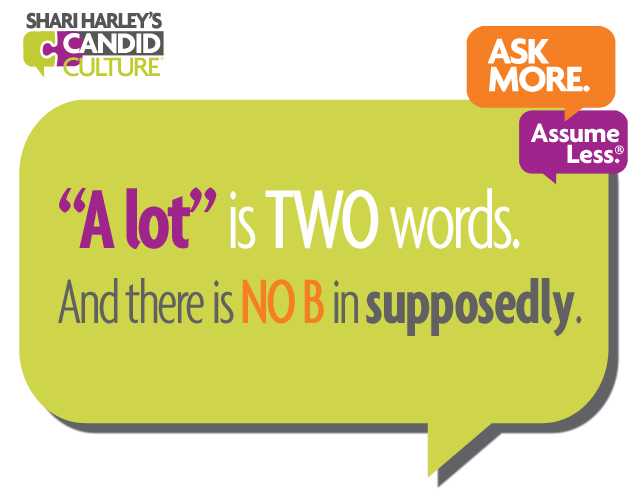
- “A lot” is two words.
- Incentify is not a word. Incent is.
- Too means also. To does not.
- There is no B in supposedly.
- Your crazy aunt can only visit once a year without you wanting to change your address, and this does not mean that you’re a bad person.
- You accept advice. You advise others.
- There is no X in especially.
- You lose your marbles when you don’t get enough sleep. Your jeans become loose when you stop eating Snickers bars.
- You accept advice, except when you think the other person isn’t the sharpest tool in the shed.
- Irregardless is not a word. Regardless is.
- “Where you at?” “Where are you,” will do.
- Please put your contact information on the bottom of your initial and reply emails. This is not a grammar thing, it would just be helpful.
Call me picky or old school. But I suspect that when you hear these errors made in conversation or see them in writing, you judge the other person. I know most hiring managers do. Hiring managers want to know employees can write reports and email clients without embarrassing the company.
You will be eliminated as a job candidate if your resume has typos. People will judge you when you use incorrect English. They won’t tell you they’re judging your bad grammar. They’ll do it quietly or talk about you when you’re not there.
I spoke at a conference a few weeks ago where an attendee asked how to tell an employee she was going to be fired because her writing was so poor. She maintained client files and wrote client correspondence. Clients’ names were often wrong, in her written notes, as was spelling and grammar. The typos and grammar errors were a deal breaker. And they may be in your job as well.
Have someone proofread a few of your emails and reports, and ask for feedback on your writing. Ask the coworkers you’re close to to tell you when you make grammar errors in meetings. Of course you want them to tell you privately, after the meeting.
I write a bi-monthly column for the Denver Business Journal. I’m grateful that my editor reads this blog and emails me the typos and errors I make. I am not exempt.
Clean up your bad grammar and your writing, and accelerate your career. I promise it will work.
Reading emails as they come in is killing your productivity.
You’re at your desk working on a project. Aka, doing actual work. You think, “It’s been three minutes. I should check my email.” So you take your attention off your project and check your email. Then you read the next two emails that come in and check your voicemail. You then go back to the project you were working on and spend 10 to 20 minutes trying to get your head around what you were doing before reading all of those very important emails. Finally, you’re back in the groove. You do five minutes of work and think, “I should check my email.” Then it’s 5:30 pm and you realize, with frustration, that you finished nothing all day.
 Sound familiar?
Living in our email inbox is why many of us start work at 5:00 pm or come into the office at 7:00 am to get “something done while it’s quiet.” It’s why we sleep and go on vacation with our phones, and are never really off.
I am most productive on airplanes without WIFI. Without WIFI I’m not tempted to check my email every three minutes or check Facebook to read about what people I barely know and don’t really care about are doing.
Without WIFI all there is to do is what I need to do. There are no other meaningful distractions, except for the B-grade movie I didn’t really want to see anyway. I am focused. And as a result, I get a lot done. I’m also less stressed. Because I’m focused, doing one thing a time, I’m not worried about everything I still need to do.
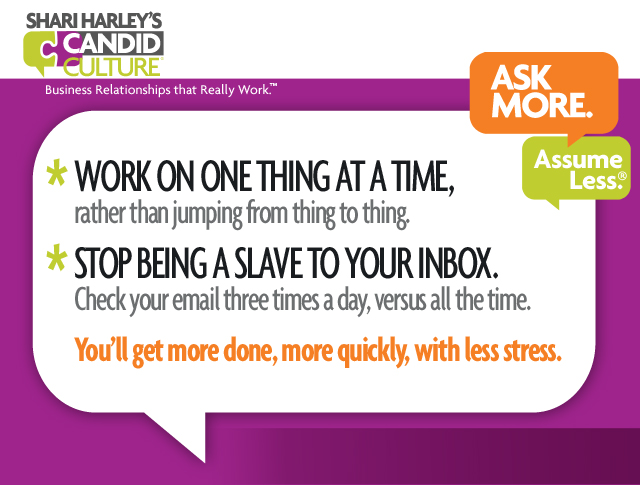
If you want to get more done and be less stressed, do one thing at a time, for a defined period of time. Decide how long you’re going to work on something, and work on that item for that period of time, with no distractions or interruptions. You may only work on something for ten or twenty minutes, but do only what you said you would do for that time period. Then you can check your email.
Productivity experts suggest you only check your email three times a day, for example, once in the morning, right before or after lunch, and at the end of the day. I find this hard to do. Like you, I feel pressured to check my inbox. Or I use my email to avoid the work I really need to do. But I know that constantly being in my email inbox has me distracted and not doing the work I really need to do. And as a result, I’m stressed and spend my evenings and weekends working on projects that require focused time.
Do one thing at a time, for a defined period of time. Just try it. If you’re going to read your email, give yourself 20 minutes, and do nothing but read, reply, and delete email. At the end of 20 minutes, do whatever you said you would do next, for as long as you decide, and nothing else.
See if you get more done, in less time, with less stress. You might just leave work earlier and have time to do something besides work.
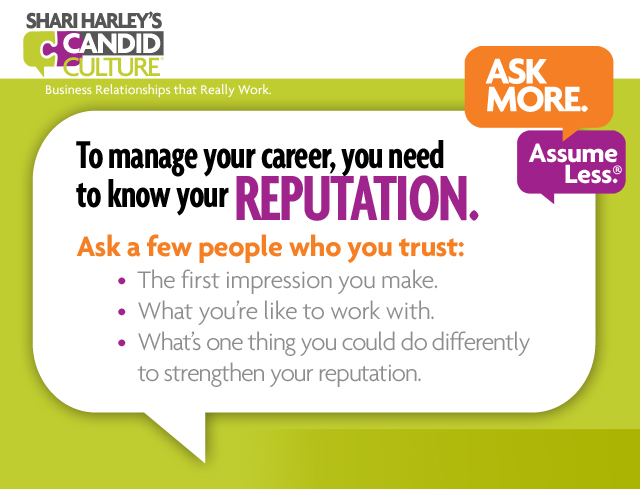 Unfortunately you probably already know that people have a tendency to talk about you, not to you. It’s human nature. Sometimes it’s gossip. Other times senior leaders talk about your future with the organization. If you want to advance your career, you need to know what the people whose opinions you care about say about you when you’re not there.
Unfortunately most people get very little feedback at work. If today was the day of your performance appraisal and I asked how your boss and whoever else provides input on your review would rate you, you probably don’t know. This lack of knowledge prevents you from advancing your career.
Not knowing someone’s opinion doesn’t mean you’re not subject to it. Akin to getting a speeding ticket when you didn’t know you were speeding. The cop doesn’t care. He adds four points to your driving record, despite that you didn’t know the speed limit.
You may work for a manager who gives feedback. You may not. It doesn’t matter. There are people in your life who will tell you the truth (as they see it), if you ask.
I recommend assembling a core group of people who you count on to tell you the truth. These are the people who know you well and have your back. They can be friends, family members, past coworkers, customers, or managers.
You might wonder, “What can my mom or friends from high school or college tell me about how I behave at work?” The answer–a lot.
We don’t become different people when we arrive at work. We are who we are. If you’re often late, break commitments, or wear clothing that’s not your friend, you do those things at home and at work. Likewise, if you have great attention to detail, never break commitments, and always look great (in public), you friends and family know.
Identify a few people, personal and/or professional, who care about you and will tell you the truth.
Tell these folks you want to eliminate your blind spots. Ask them for specific feedback, and promise that no matter what they say and how hard it is to hear, you will say “thank you.” Then be sure to manage yourself. It’s normal to become defensive when we get constructive feedback. But every time we become defensive, we train people it’s not safe to tell us the truth. If you want people to give you feedback, more than once, make it easy to tell you the truth.
You may be thinking that asking for feedback is unrealistic. People won’t be honest. And you can’t take it.
The people who really care about you will be honest, and you can take it. You’ll be fine. In fact you’ll be better off than before you had the conversations. You might hear things that pleasantly surprise you. And the things you don’t like? Just because no one talked to you about them before you asked, doesn’t mean those behaviors didn’t impact you. Now you can do something about them.
Get out of the dark and into control. Discover your reputation and advance your career.