Archive for May, 2012
A few weeks ago I flew an airline whose employees were universally nasty. Every person I interacted with –from the person who checked me in for the flight, to the gate agent who scanned tickets, to the flight attendant on the plane–was nasty without being provoked.
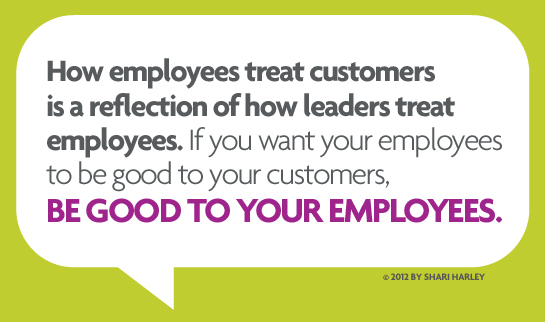
There are two reasons why employees in various roles and locations are universally nasty to customers. Either employees feel they are treated poorly by the organization’s leaders, and they knowingly or unknowingly take their frustration out on customers, or there are insufficient expectations for good customer service. Given the competitive nature of the airline industry, I’m going to assume customer service standards are in place, and employees are reacting to how they feel they’re treated by the organization.
Your employees will not treat customers better than you treat your employees. You get what you give. Expecting employees to treat customers better than the employees feel treated is akin to buying subpar building materials and expecting superior construction. It isn’t going to happen.
Your organization’s handbook and customer service training programs can outline explicit instructions for how customers should be treated, but if the practices for treating employees are markedly different, don’t expect great customer service.
This begs the question, what does it mean to treat employees well? Don’t all employees need different things to be happy? What about the differences between Baby Boomers, Generation X, and Generation Y employees?
In my experience people of all ages need many of the same things to be satisfied in a job. Employees want to learn, grow, and feel challenged. They want to work in an environment in which they feel comfortable–they like the people and feel accepted and respected. They want to make a difference and contribute to something bigger than themselves. And they want the flexibility to control their schedule and personal lives. Depending on an employee’s stage in life and career, some of these things become more important than others.
The difference between Baby Boomers, Generation X, and Generation Y: I don’t think each group needs drastically different things to be satisfied at work. In my experience, the key difference between the groups is that Baby Boomers and Gen X’ers will put up with not having everything they want. Gen Y’ers will not. Baby Boomers and Generation X will put up with a boss or job they don’t like for two years, waiting to see if things improve. Millennials are more impatient. If they don’t think they can get what they want from a job or organization, they move on quickly.
The quickest and easiest thing managers can do to engage and retain employees of all ages and stages in their careers is to ask what employees need to be satisfied. And no, employees may not tell you. There is an almost universal and pervasive fear in organizations to speak candidly with one’s manager. But employees definitely won’t tell you what they need to stay with your organization if you don’t ask. And even if employees aren’t candid about their desires, you still get points for asking the questions most managers don’t.
In every leadership, management and coaching class I teach, I ask managers to answer these questions:
• What are your employees’ career deal breakers? What would make your employees leave your organization?
• What kind of work do your employees like to do most? What kind of work do they like to do least?
• So you can provide personalized recognition they’ll appreciate, what are your employees’ favorite
hobbies, foods, and places to eat or shop?
• What are employees’ pet peeves at work?
I’ve asked these questions of thousands of managers, and few can answer the questions. If you can’t, without absolute certainty, answer these questions about your employees, don’t be surprised that you aren’t getting the performance you desire. How can you manage and motivate employees if you don’t know what’s important to them?
The easiest thing to do today to raise employee performance, and in turn improve customer service, is to ask your employees what they need, and when appropriate, give employees those things. If you can’t provide what employees what, tell employees why you can’t honor their requests. Rationale, the answer to the question why not, goes a long way.
You may be wondering, isn’t it worse to ask employees what they want and have to say no, than not to ask at all?” Quite simply, no. Not asking about employees’ needs because we may not be able to tell them yes is akin to the fallacy that if we don’t talk about something it doesn’t really exist.
Employees want what they want, regardless of whether you talk about those desires or not. I’d much rather have an open discussion about not being able to meet an employee’s needs, and know they will job hunt, then be surprised when they quit. If employees’ desires are truly deal breakers, you’ll lose them anyway. If you know what employees want, you can negotiate and attempt to meet some or all of their needs, giving you more control over employee engagement and retention.
Ask what employees need to stay with your organization and be satisfied, and watch performance, morale, and customer service rise.
PowerPoint is the worst thing that ever happened to speakers and presenters. When used well PowerPoint adds depth to presentations and a visual component that many people need to digest information. But most presenters misuse PowerPoint, overloading slides with too much data and text that is too small to read, that they cover too quickly.
Presenters are thinking through and designing their presentations in PowerPoint. Meaning, most people open a blank presentation and type as they’re thinking about what they want to say. This is not a bad practice in and of itself. It’s only bad if presenters don’t remove the words they should say during a presentation, but not put on the slides.
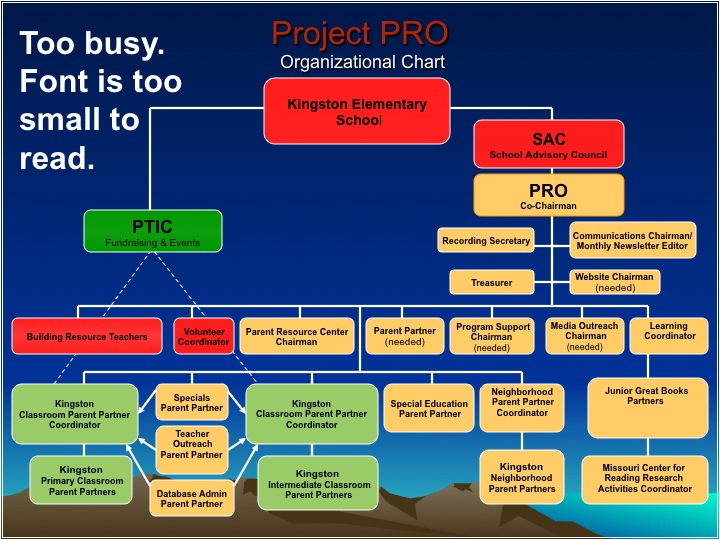
Examples of common but ineffective slides are below.
Creating a presentation should mimic packing for a trip. We throw everything we want to take with us on the bed. Then we stuff everything in a bag. When we see it’s not all going to fit, we take stuff out. Then we realize we’re going to pay an overweight fee, so we take more stuff out, admitting that we don’t need eleven t-shirts. We then get where we’re going with much less stuff than we started with, but still more than we need. Creating a presentation should follow the same process.
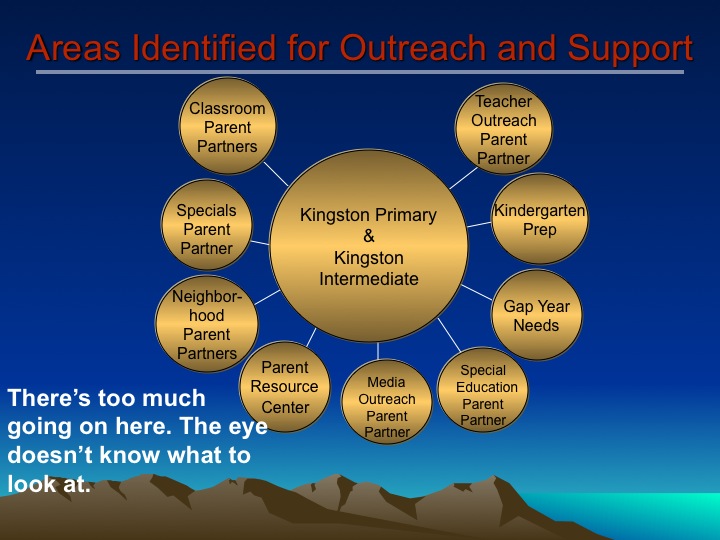
Create your presentations in PowerPoint and then remove everything but the necessary points your audience needs to follow your presentation. Leave bullets that you will discuss in greater detail, important numbers, and statistics. Delete the rest. If your slides mimic every word you’re going to say, the audience doesn’t need you. If you’re going to read your slides, save your audience some time, email the presentation, and cancel your meeting.
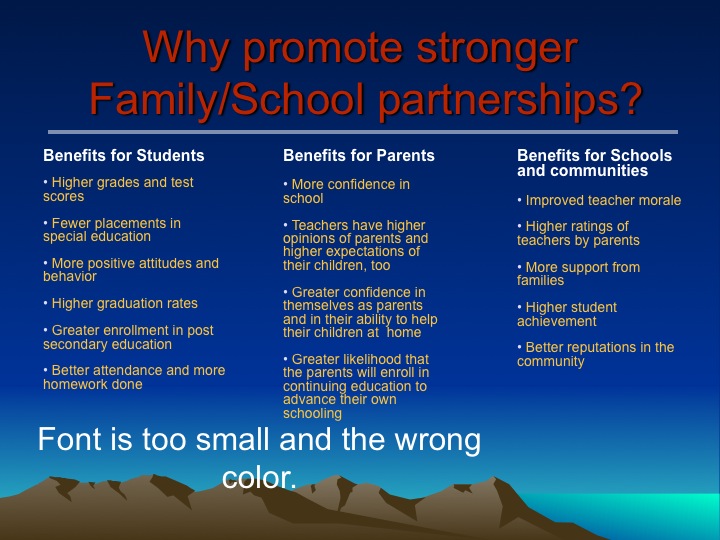
If you want to hand out or use a more detailed version of the presentation to prompt you while you’re speaking, save two versions –version one with all the detail and a parsed down version two to project while you’re speaking. The notes feature is a good place to put extra detail you want to be sure to cover, but don’t want on your slides.
The objection I often get to the suggestion above is, “I have to provide a lot of information. I know it’s too much data for one slide and the text is too small to read. But I have to provide that level of detail.” When you have a lot of information you can put it on a slide, but you should also provide the slide as a handout. Tell people you know they can’t read all the information on the slide, and tell them to follow along on their handout. Use a pointer or a different color to highlight the sections of the slide you’re talking about. If you aren’t going to give a handout, then remove the slide from the deck and email it as follow up. Showing slides that are too small or too detailed to read is frustrating for your audience and doesn’t put you in the most positive light.
Avoid Death By PowerPoint and Make PowerPoint Work For You:
- Use 24-point font or larger. People can’t read 14 or 16 point font on a slide.
- Put 6 to 7 lines of text on a slide, not more.
- Avoid distractions on slides –like images that float in or explode. Make your slides more interesting by adding relevant pictures and videos, versus unrelated images.
- Always speak with the lights full up. NEVER speak in a dim or dark room. YOU are the presentation, not your PowerPoint slides.
- Use a white background and a dark font, so you NEVER have to dim the lights.
- Use fewer slides than you think you need to, and give your audience time to read each slide. If the audience doesn’t have time to read a slide, they will feel ripped off and frustrated, and wonder what they’re missing.
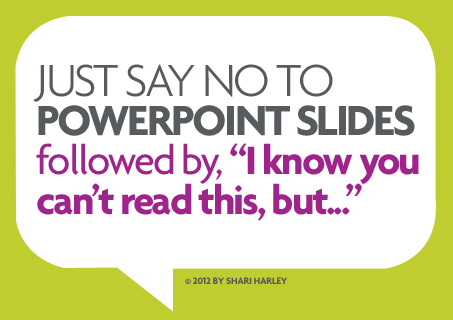
PowerPoint can be a great tool, when used well. If your slides add to, but don’t replace your message, and if everyone in the room can and has time to reach every word on your slides, you’re using PowerPoint as it was intended. If your slides can be followed by the words, “I know you can’t read this but…,” it’s time to start deleting.
Five years ago today, I left my secure, corporate job to start Candid Culture, an international training and consulting firm, bringing candor back to the workplace, making it safe to tell the truth at work. Leaving the security of a regular paycheck was one of the scariest things I’ve ever done, so scary that I talked about it for 12 years before finally taking action. After talking with friends and family about starting this business for so long, that they cut me off, on May 14th, 2007 I quit my job and left for Singapore to speak at my first international conference.
I wasn’t ready. I had no prospects and no plan. I didn’t think I’d be successful. In fact, I was reasonably convinced I’d fail. I was consumed with fear. But for the first time, my desire had become greater than my fear.
 Two things moved me out of vacillation and into action.
Catalyst #1: For the first time in my career, I had a job I didn’t like. Before my last job, I would have done every career-related (a.k.a. real) job I’d had for free. In my last job I made a lot of money but was unhappy. I swore I’d never be someone who kept a job for the money.
Catalyst #2: I didn’t want to look back at the end of my career and wonder, what if? When I was in high school I was captivated by the Henry David Thoreau quote, “I want to live deep and suck the marrow out of life.” I made a decision then that I would not live my life controlled by fear.
So I quit.
My definition of success was low. All I wanted was to be able to pay my mortgage and not live under a bridge or with my parents. Given how low I set the bar, it’s amazing my first year in business with Candid Culture was as good as it was.
The past five years have been the most fun, rewarding time in my life. I’ve had the privilege to speak in seven countries and on three continents, in 23 states, and with organizations of all types and sizes.
Our work is different. It is edgy and direct and rarely what people are expecting. I cherish the feedback from conference attendees and clients, “You are a breadth of fresh air.” I can’t imagine being told anything better. Fresh implies different. And different can be scary.
We help organizations shift from cultures of silence and fear to a climates of candor and trust. Creating a more candid culture takes courage.
Thank you for your courage and your trust, and for believing that your organization can be a place people want to work and where they do their best work. I look forward to the next five years.
Think about all the people in your life who frustrate you. The employees who turn in work without checking for errors. The person who offices next to you and takes phone calls via speaker phone. The person who is always late for meetings and then proceeds to text under the table, like no one can see him. And in personal relationships, our friends who come late, cancel, or just aren’t in touch as often as we’d like.
These situations annoy us, but we often don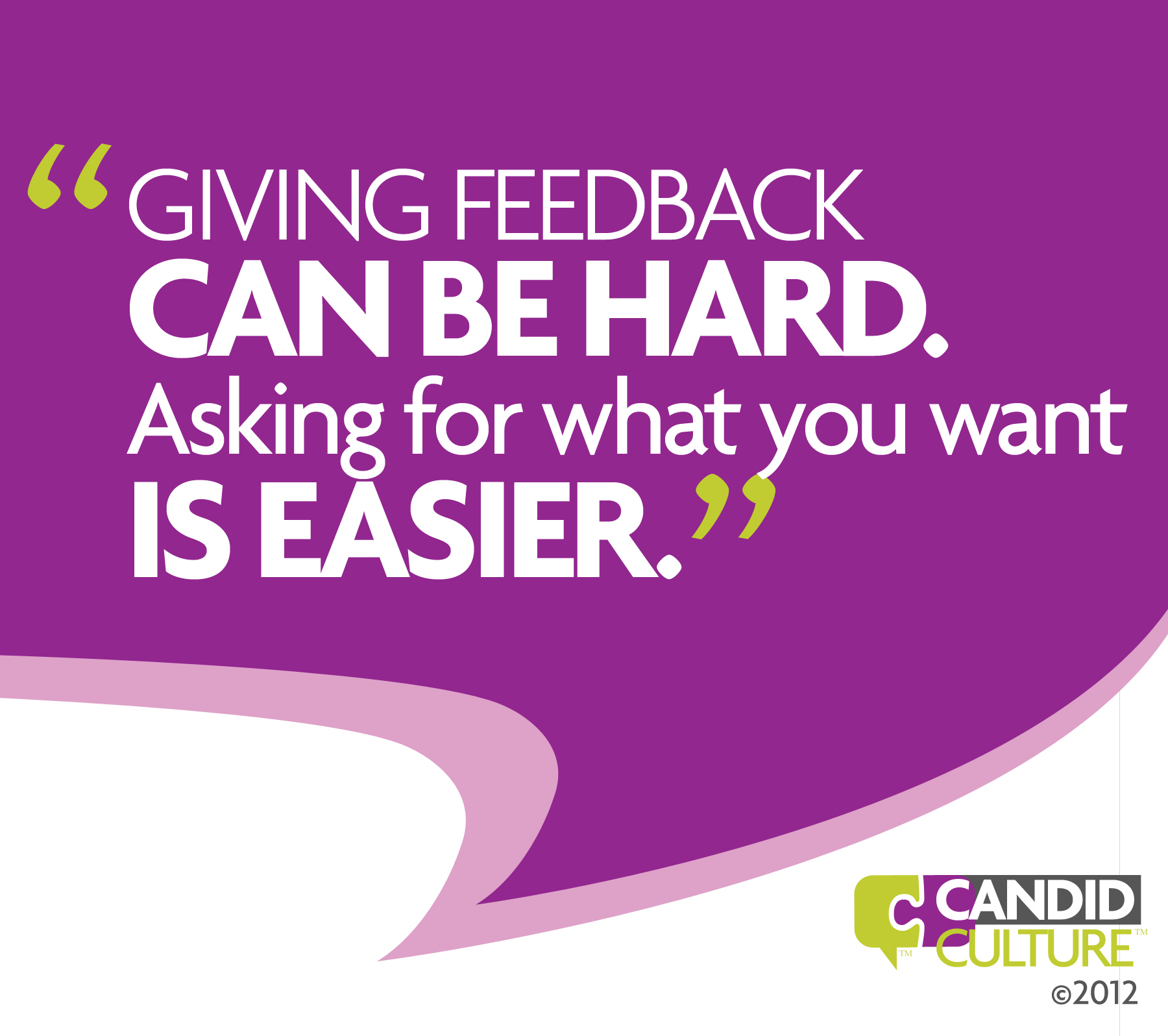 ’t say anything because giving feedback is simply too hard. Why risk the person’s defensiveness? Or we don’t think addressing the situation will make a difference.
Giving feedback can be hard. Asking for what you want is easier, but most of us don’t do it.
The question is why? If making a request is easier than correcting someone’s behavior, why not ask for what you want upfront? Why wait until expectations are violated to make a request? The answer is simple.
We don’t think we should have to make requests. We assume our employees, coworkers, and friends will do things as we do.
We would never turn in work without checking it for accuracy or come to a meeting late. So we assume others won’t either. And when they do, it feels too hard to speak up, so we don’t.
I’m going to suggest you approach relationships differently –more proactively.
Ask for what you want at the beginning of a relationship, project, meeting – anything new. Set clear expectations. If you want to start and end meetings on time, tell people that during your first meeting. And if you have an existing behavior you want to shift, simply say, “I realized I didn’t tell you that starting and ending meetings on time is really important to me. Going forward, we’re going to start and end all meetings on time. So please be ready for that.” If you need a quiet work environment, when you get assigned a new desk or seat mate, tell your coworkers that you are easily distracted by noise and ask them to take all calls via a hand or head set and to limit posses of visitors. If it bugs you when people wear shoes in your house, tell them when they arrive. Don’t expect people to guess you’re frustrated and alter their behavior without you making a request. It’s not going to happen.
Consider all the things that annoy you. Then consider what you did or didn’t ask for. If you haven’t made your expectations clear, it’s not too late. Asking for what you want is easier than you think.