Archive for April, 2012
Dating turnoff: A guy who tells me negative things about other women he’s dated. If he’ll talk smack about other women to me, he’ll talk poorly about me to other people. I know I’m special, but I’m not different. And neither are you.
If your coworkers talk to you about other people in your office, why wouldn’t they talk to others about you? Likewise, if you talk to your friends at work about all the dolts you’re forced to work with, why shouldn’t your friends assume you will talk negatively about them. Like you, they’re special, but not different.
Workplace gossip exists in every organization everywhere. It’s been around forever and is here to stay. The problem is that gossip creates environments of suspicion and fear and kills organizational cultures. Employees watch his or her back, wondering from where the next jab and stab will come. And when people are worried about how others will damage them, they work alone versus together. They hoard information and recognition. All of this is, of course, very bad. But the distrust and paranoia that gossip creates isn’t the only reason to reduce the gossip in your organization.
An even more compelling reason to reduce the amount of workplace gossip — it’s exhausting.
My clients split hairs attempting to convince me that gossip and venting are not the same thing. They insist that venting is productive—it allows people to blow off steam and problem solve. Here is my one word reply: Garbage. That is complete garbage.
Although I am the least woo-woo person I know, this next thought may sound a little woo-woo. So hang in there with me. If an hour after a meeting you and your work friends are still talking about how inept the meeting facilitator is, you might as well still be sitting in the meeting. If you go home after work and complain to your spouse about the people you work with who do little work, then you might as well still be at work. You life is what you talk about and with whom. That’s the woo-woo part.
If you want a different experience, say something different. If the meetings in your office are ineffective, talk to the meeting facilitator off line. Offer suggestions; offer to run the meeting, or stop going. Do anything but talk to people who can’t impact the situation. If you’re working harder than the people around you, either talk to them or your manager, or simply do less. Sometimes we have to let things break for others to know they are broken.
Whatever you choose to do, know that talking about the things that frustrate you to people who can’t do anything about them makes you feel worse not better.
I’ve already conceded that workplace gossip isn’t going anywhere. So what to do?
Here are a few things you can do in your office to create a more positive and trusting culture:
- When you find yourself talking negatively about someone who isn’t present, stop.
- If there is something you’re unhappy with at work, tell someone who can do something about it. Just be careful not to dump a problem at a manager’s door. It burdens managers who are already too busy and annoys them. State your observation; recommend a solution; ask for their support if you need it.
- Create a no workplace gossip policy in your office, and charge a $1 every time you hear gossip. The money can go to charity or towards funding company parties. People are hesitant to part with their money. You’ll be surprised at how much $1 can alter behavior. The people you work with may look at you funny, but they know how badly it feels to be thrown under the bus. Others will, in time, appreciate the policy. Working in an environment where you know others won’t talk about you when you’re not there creates an unprecedented feeling of confidence few of us will ever experience.
Ultimately the answer is simply to: Desire to have a different working environment and draw attention to the gossip you hear. That alone will help. You want people to trust you. And you want to work with people you trust. One of the fastest ways to build and repair trust is not to speak negatively about the people you work with. Plain and simple.
I’m reasonably sure I got fired from my college teaching job. Two students went to the Dean to complain about me, and Deans generally don’t like dealing with annoyed students.
What did I do to incense my students to the point of complaint? I gave them a grammar lesson.
I was teaching a graduate level leadership class. While reading my students’ first papers, I found myself correcting their grammar – for an hour, per paper. I found the papers too hard to read without fixing the grammar.
When I handed the papers back I told my students, “You want to be leaders. Not being able to write will hold your career back more than your leadership abilities. So we’re going to work on writing today.” Then I reviewed some basic grammar rules. The students who complained said that they weren’t paying to learn how to write. They were paying to learn how to be leaders.
They missed the lesson.
When I screen resumes, I eliminate candidates whose resumes have typos and spelling errors. And many other managers do as well. A resume is like a first date. You’re working to impress. And as my dad says, it doesn’t get any better than it is at the beginning. If your date behaves badly early on, it will only get worse. If candidates don’t pay attention to their own marketing tool, why would they pay attention to yours?
Some people say that the prevalence of texting and Instant Messenger has changed the standards of what type of writing is acceptable at work. I disagree.
When clients receive proposals with errors, do they want to hire you? When you send an email or report with grammar errors or typos to the people in your office who can impact your career, do they dismiss the errors or make a mental note that you’re careless? I suspect the latter.
Being successful at work is hard enough. Don’t give people a reason to discredit you.
- Spell check your work
- Be succinct. If you can say it in 10 words, eliminate the extra 20 you’ve written.
- If you are struggling with writing, take a class.
Little things matter.
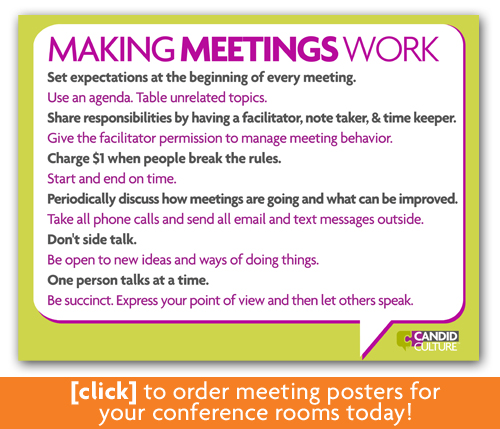 Meetings start and end late. Attendees slyly send text messages under the table, like no one can see them. Decision makers are absent, requiring you to have another meeting. One person talks most of the time, while everyone else tunes out.
The meeting facilitator wants to do something but feels like s/he can’t. How do you tell someone two levels above you to put away his phone and pay attention?
The majority of meetings are too long and a poor use of time.
You can impact the meetings in your organization, even if you don’t run them.
The bad meeting behavior mentioned above is predictable. It’s happening everywhere.
If you want your meetings to be different, ask for something different, before problems occur.
The reason your meeting facilitators feel as if they can’t tell their boss’s boss to show up and pay attention is because there has been no expectation set that it’s ok to do so. Meeting guidelines have not been established. And if they were established it was done long ago and the expectations were long forgotten.
Running an effective meeting requires courage AND an understanding that the meeting facilitator has permission and is expected to address people who break the rules. Even the most senior person in the room has given the facilitator permission to correct him. Without this permission, your facilitator can’t say anything, which is why s/he doesn’t.
How to have better meetings. Follow these meeting guidelines:
- Get meeting attendees’ agreement on the meeting guidelines.
- Give the meeting facilitator AND attendees permission to enforce the meeting guidelines.
- Take two minutes to set expectations before every meeting. Yes every meeting, even standing meetings. People forget. When you remind people of the rules, it’s easier to enforce them.
- Post the meeting guidelines in all of your conference and training rooms as reminders. Make the posters with large font that can be read from any seat in the room. We’ve made it easy for you with our Make Meetings Work Poster.

- Periodically discuss how meetings are going – what’s working and what can be improved. Create occasions and grant permission to give feedback. If it isn’t safe to tell the truth, nothing will get better.
Stop wasting your time in meetings. It’s never too late to set expectations. Hang them up on the wall for everyone to see. Anyone, at any level, and in any role can suggest setting and adhering to meeting guidelines. People in your organization want someone to take control. Maybe it will be you?
Looking for a 5 10’, 45 year-old with some of his hair. Must enjoy long walks on the beach, dogs, and great conversations. No baggage please!!
At work this might sounds like, looking for employees who will do good work with little to no oversight, be open to feedback, and never get defensive, no matter what bad news we give them. Otherwise known as, no baggage.
Unless you work alone, you know that people come with baggage. I’m calling our negative experiences with other people –parents who lost their tempers when we expressed a counter point-of-view, bosses who punished us for saying what we really thought, and peers who killed us off when we told them the truth – baggage. Every time we got yelled at, in trouble, or punished in any way for giving feedback, we learned it was not safe to speak up.
Your direct reports and coworkers have been trained by every person who came before you, both personally and professionally. We have all been trained.
We all know that when we tell most people what we really think, and they don’t like it, there are negative consequences. So we learn, pretty quickly, to keep our opinions to ourselves.
If you want people to tell you the truth about what’s not working in your organization or about your own performance, you need to retrain them. You need to get your employees and coworkers to believe that it’s safe to tell you the truth, even when the news is bad.
So how do you make people feel safe giving feedback and speaking up? Be open to feedback:
- Ask for their opinion.
- Promise that no matter what they tell you, you will say “thank you”.
- Manage yourself and ensure the other person felt heard. Say “thank you” out loud, regardless of what you say inside your head.
- Then walk away.
- Once you’ve had some time to process the feedback, you can go back to the person to discuss it.
- If you got defensive, apologize and recommit
Every time you get defensive you train people it’s not safe to tell you the truth. The more often you ask for input and are open to feedback, the more information you’ll get.